
 French
 English
 Dutch
Microwave synthesis vs. conventional heating
Compare microwave synthesis and conventional heating in laboratory chemistry. Explore heating principles, reaction times, advantages, limitations and applications.
An essential role in chemical synthesis
Heating plays an essential role in chemical synthesis, influencing reaction rates, conversion, selectivity and overall process efficiency. For decades, conventional heating methods such as oil baths, heating mantles and hotplates have been widely used in laboratories to provide the thermal energy required for chemical reactions.
However, microwave-assisted synthesis has become an established alternative for many laboratory-scale reactions, offering a different approach to heating reaction mixtures. By using microwave energy to heat suitable materials directly, this technique can provide rapid heating and controlled reaction conditions.
What is conventional heating in chemical synthesis?
Conventional heating refers to methods in which thermal energy is transferred from an external heat source to a reaction mixture. Common laboratory equipment includes hotplates, oil baths, heating mantles and heated reactor systems.
In these setups, heat generally passes from the heating source through the reaction vessel walls before reaching the reaction mixture. The energy is then distributed through the liquid by conduction and convection, often supported by mechanical or magnetic stirring.
Because heat must travel through the vessel and reaction medium, the heating rate depends on several factors, including:
- The thermal conductivity and geometry of the reaction vessel
- The volume and physical properties of the reaction mixture
- The temperature difference between the heating source and the reaction medium
- The efficiency of mixing and heat transfer
Conventional heating is widely applicable and can be used for a broad range of reaction volumes and laboratory processes. However, depending on the setup, it may require more time to reach the desired reaction temperature, particularly when heat transfer is limited.
What is microwave-assisted synthesis?
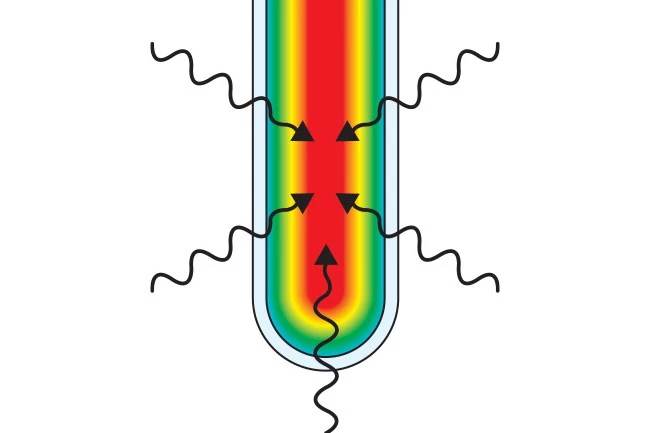
Microwave-assisted synthesis is a chemical synthesis technique that uses microwave electromagnetic energy to heat reaction mixtures. Unlike conventional heating, where energy is supplied through an external heated surface, microwave heating can transfer energy directly to components of the reaction medium that absorb microwave radiation.
This process is known as microwave dielectric heating.
Microwave heating primarily occurs through two mechanisms:
Dipolar polarisation: Molecules with permanent or induced dipoles respond to the alternating electric field. Energy is dissipated as heat as the molecules interact with the oscillating field.
Ionic conduction: Dissolved ions move in response to the alternating electric field, resulting in energy dissipation within the reaction medium.
The efficiency of microwave heating depends on the dielectric properties of the complete reaction mixture, including solvents, reagents and other components.
Dedicated microwave synthesis instruments are designed to control reaction parameters such as temperature, heating time and, in suitable sealed-vessel configurations, pressure.
Importantly, microwave-assisted synthesis does not rely on microwave photons directly breaking chemical bonds. The primary mechanism responsible for accelerating most microwave-assisted reactions is thermal: rapid heating and the ability to reach appropriate reaction temperatures.
Microwave synthesis vs. conventional heating: key differences
Although both methods supply thermal energy to chemical reactions, they differ in how heat is generated, transferred and controlled.

Parameter | Conventional heating | Microwave synthesis |
Heating mechanism | External heat transfer through the vessel | Dielectric heating of microwave-absorbing components |
Heating rate | Depends on external heat transfer | Can provide rapid heating of suitable mixtures |
Temperature distribution | Influenced by vessel walls, mixing and heat transfer | Influenced by microwave absorption, vessel geometry and mixing |
Reaction time | Depends on reaction chemistry and temperature | May be shorter for suitable reactions |
Temperature control | Depends on the heating system | Controlled through dedicated microwave instrumentation |
Pressure conditions | Atmospheric or pressurised, depending on equipment | Atmospheric or sealed-vessel operation, depending on equipment |
Reaction volume | Wide range of laboratory and industrial scales | Depends on instrument and vessel configuration |
Energy consumption | Depends on the heating setup and process | Depends on microwave absorption, equipment and process |
The most significant distinction is the way energy enters the reaction system.
With conventional heating, the vessel walls are generally heated before energy is transferred to the reaction mixture. With microwave heating, microwave-absorbing components of the reaction medium can generate heat internally.
This difference can reduce the time needed to reach a target temperature, although the result depends on the reaction mixture and equipment.
It is also important to distinguish between faster heating and faster reaction kinetics. A microwave-heated reaction may reach its target temperature more quickly, but that does not necessarily mean the underlying chemical reaction proceeds faster than an equivalent conventionally heated reaction maintained at the same temperature.
What are the advantages of microwave-assisted synthesis?
Faster heating and potentially shorter reaction times
One of the most widely reported advantages of microwave-assisted synthesis is the ability to heat suitable reaction mixtures rapidly.
In conventional heating systems, the rate of temperature increase is influenced by heat transfer through the vessel and surrounding medium. Microwave heating can reduce some of these heat-transfer limitations by generating heat directly within microwave-absorbing materials.
As a result, certain chemical reactions can be completed in shorter overall processing times. In some cases, microwave synthesis also enables reactions to be conducted at elevated temperatures in suitable sealed vessels. Higher reaction temperatures can accelerate chemical reactions according to established reaction kinetics.
However, shorter reaction times are not guaranteed for every chemical transformation. The actual benefit depends on the reaction chemistry, temperature, solvent and operating conditions.
Controlled reaction conditions
Dedicated microwave synthesis instruments provide controlled heating programmes, allowing researchers to define and monitor reaction conditions. Depending on the instrument, parameters may include temperature, reaction time, microwave power and pressure.
This level of control is useful for reaction development and optimisation, particularly when researchers need to compare multiple experiments under defined conditions.
Conventional heating systems can also provide precise temperature control. The difference lies primarily in the heating mechanism and the available instrument functions rather than an inherent inability of conventional systems to control temperature.
Potential improvements in reaction yield and selectivity
Some published studies report improvements in product yield, purity or selectivity when microwave-assisted synthesis is used instead of conventional heating.
These improvements may result from shorter exposure to elevated temperatures, different heating profiles or the ability to perform reactions under different temperature and pressure conditions.
However, microwave irradiation does not inherently improve the yield or selectivity of every reaction.
When comparing microwave-assisted and conventionally heated reactions, scientists should consider whether both experiments were conducted under equivalent conditions.
Efficient reaction screening and optimisation
Microwave synthesis can be particularly useful in laboratories performing repeated synthesis experiments. Rapid heating and programmable reaction conditions can help researchers investigate different temperatures, reaction times and experimental parameters.
For medicinal chemistry and chemical research laboratories, these capabilities can support workflows involving the preparation and evaluation of multiple compounds.
Depending on the instrument configuration, additional automation options may further support repeated experimental workflows.
What are the limitations of microwave synthesis?
Despite its advantages, microwave-assisted synthesis is not necessarily the most appropriate heating method for every reaction.
Solvent and reaction mixture properties
The efficiency of microwave heating depends on the ability of the reaction medium to absorb microwave energy. Highly microwave-absorbing solvents and ionic reaction mixtures can heat efficiently, while materials with low dielectric losses may absorb microwave energy less effectively.
However, solvent polarity alone does not determine whether a reaction is suitable. Reagents, catalysts, salts and other components can also influence microwave absorption. Consequently, the behavior of the complete reaction mixture should be considered.
Reaction volume and scalability
The maximum reaction volume depends on the microwave instrument, vessel configuration and operating conditions. Laboratory microwave synthesis systems are particularly useful for small-scale synthesis and reaction development, while larger-scale processing may require different reactor designs or specialized equipment.
Transferring a microwave-assisted reaction to a larger scale requires consideration of microwave penetration, energy distribution, mixing, temperature control and process safety.
Pressure and vessel compatibility
Some microwave synthesis workflows use sealed vessels to operate at elevated temperatures and pressures. These conditions require appropriately rated reaction vessels and suitable pressure management.
Not every reaction or reagent is compatible with sealed-vessel operation. Gas formation, exothermic behaviour, solvent properties and instrument limitations must be considered when selecting operating conditions.
Equipment requirements
Conventional heating equipment is widely available in chemical laboratories and can be suitable for many routine reactions. Microwave synthesis requires dedicated instrumentation and compatible reaction vessels, which may represent an additional equipment investment.
The decision to use microwave synthesis should therefore consider both the potential experimental benefits and the practical requirements of the laboratory.
Applications of microwave-assisted synthesis
Microwave-assisted synthesis is used across several areas of chemical research, particularly where rapid heating and controlled reaction conditions are valuable.
Organic synthesis
Microwave-assisted heating is well established in organic chemistry and has been investigated for a wide range of synthetic transformations. Applications include various substitution, condensation, coupling and cyclisation reactions, provided the reaction conditions and materials are suitable.
For laboratory researchers, microwave synthesis can offer an alternative heating approach when investigating reaction conditions or developing new synthetic methods.
Medicinal chemistry and pharmaceutical research
Medicinal chemistry often involves the preparation of multiple compounds for evaluation during research and development. Microwave-assisted synthesis can support these workflows by enabling rapid heating and controlled reaction conditions for suitable transformations.
This can be valuable during compound synthesis, reaction optimization and the exploration of alternative synthetic routes. The potential benefit depends on the specific reaction rather than the application field alone.
Inorganic chemistry and materials science
Microwave heating is also used in inorganic synthesis and materials research. Depending on the chemistry, applications may include the preparation of inorganic compounds and certain nanomaterials.
In these processes, microwave absorption by solvents, precursors or other components can influence heating behaviour and reaction conditions.
The suitability of microwave synthesis depends on the material system, desired product properties and experimental setup.
Academic research and laboratory method development
In academic and research laboratories, microwave synthesis provides an additional heating technique for investigating chemical transformations. Researchers can compare heating methods, explore reaction parameters and study how temperature and processing conditions influence reaction outcomes.
Dedicated microwave instruments can also support reproducible experimental workflows by allowing reaction conditions to be programmed and recorded.
When should you choose microwave synthesis instead of conventional heating?
Choosing between microwave synthesis and conventional heating depends on the reaction requirements and the objectives of the laboratory.
Microwave-assisted synthesis may be worth considering when:
- Rapid heating is important for reaction development or screening.
- The reaction mixture is suitable for microwave dielectric heating.
- Controlled temperature profiles are required.
- Suitable sealed-vessel operation could provide useful reaction conditions.
- The laboratory regularly performs small-scale synthesis experiments.
Conventional heating may remain preferable when:
- Existing heating equipment already provides satisfactory reaction performance.
- The required reaction scale exceeds the capabilities of the available microwave system.
- The reaction mixture is poorly suited to microwave heating.
- The process requires equipment configurations or operating conditions not supported by the microwave instrument.
For a meaningful comparison, researchers should evaluate reaction conversion, product yield, selectivity, heating time and total processing requirements under appropriately controlled conditions.
Ultimately, neither heating method is universally superior. The most suitable approach is the one that provides the required reaction performance, control and practicality for the intended application.
Our microwave synthesizer for chemical synthesis
ChemSPX supplies microwave synthesis equipment to laboratories, research institutions and industrial R&D facilities in Belgium, the Netherlands and Luxembourg.
The Discover 2.0 is designed for organic and inorganic chemical synthesis, offering controlled microwave heating and temperature and pressure management. The system supports 10 mL, 35 mL and 100 mL pressurised reaction vessels and features iWave® temperature sensing, ActiVent® pressure management, variable-speed magnetic stirring and rapid compressed-air cooling.
Its features include:
- Pressurised reaction vessels: 10 mL, 35 mL and 100 mL vessel options
- iWave® temperature sensing: Infrared temperature measurement through compatible glass and Teflon® vessels
- ActiVent® pressure management: vent-and-reseal technology for managing overpressure
- Variable-speed magnetic stirring: supports mixing during reactions
- Compressed-air cooling: enables rapid cooling of the reaction vessel
- Optional upgrades: including autosampler configurations and additional application accessories

Discuss your application with our Xperts
Our Xperts are happy to discuss your application and help you find the right solution.
FAQ
Is microwave synthesis faster than conventional heating?
Microwave synthesis can provide faster heating and shorter reaction times for suitable chemical reactions. However, the improvement depends on the reaction mixture, temperature and experimental conditions. Not every reaction benefits from microwave heating.
Does microwave synthesis improve reaction yields?
Some reactions show improved yields or selectivity under microwave-assisted conditions. These improvements are reaction-dependent and may be associated with differences in heating profiles, reaction temperatures or processing times. Higher yields are not guaranteed.
Can microwave synthesis be used for organic and inorganic chemistry?
Yes. Microwave-assisted synthesis is used in both organic and inorganic chemistry, including medicinal chemistry, materials research and laboratory method development. The suitability of the technique depends on the specific reaction and materials.
Which solvents are suitable for microwave synthesis?
Solvent suitability depends on dielectric properties, chemical compatibility and the intended reaction conditions. Polar solvents often absorb microwave energy effectively, but the dielectric behaviour of reagents and other components also influences heating. Solvents with low microwave absorption may still be usable in suitable reaction mixtures.
Can microwave synthesis replace conventional heating?
Microwave synthesis can replace conventional heating for certain laboratory reactions, but it is not a universal replacement. The choice depends on reaction chemistry, required scale, heating performance, equipment capabilities and process requirements.
Is microwave synthesis more energy-efficient than conventional heating?
Microwave heating can reduce energy use in certain applications by delivering energy directly to microwave-absorbing materials and reducing heating times. However, overall energy efficiency depends on the equipment, reaction conditions, heating duration and system energy consumption. It should be evaluated for the specific process.
Transparency note: this article was developed with AI assistance and checked for technical accuracy. While we strive to provide reliable and up-to-date information, we recommend verifying critical technical details against original scientific sources and official manufacturer documentation.