
 English
 Dutch
 French
Lauda Natural Refrigerants
LAUDA is a global leader in precise temperature control solutions, offering a wide range of products from compact laboratory thermostats to fully customized heating and cooling systems for industrial applications. Sustainability plays an important role in the development of these systems, with a strong focus on energy efficiency, reduced CO₂ emissions and the use of natural refrigerants.

Innovation meets sustainability
According to LAUDA, approximately 95% of a product’s lifetime CO₂ emissions occur during operation. This makes energy efficiency during daily use an important factor in reducing the environmental impact of temperature control equipment.
What are natural refrigerants?
Natural refrigerants are substances that occur naturally in the environment and can be used as cooling agents in refrigeration and temperature control systems. Common examples include carbon dioxide (CO₂, R744), propane (R290) and ammonia (R717).
Unlike many conventional fluorinated refrigerants, natural refrigerants generally have a very low Global Warming Potential (GWP), making them attractive alternatives for reducing the direct climate impact of refrigeration systems.
GWP measures the warming effect of a greenhouse gas relative to carbon dioxide over a specified period, typically 100 years. CO₂ serves as the reference with a GWP of 1.
For laboratory and industrial cooling applications, LAUDA focuses on natural refrigerants such as R744 and R290, depending on the required cooling performance, operating conditions and system design.
Why are natural refrigerants important in cooling systems?
Refrigeration and temperature control systems are essential in laboratories, research facilities and industrial processes. However, their environmental impact depends on more than the refrigerant alone.
Two important factors influence the climate impact of a cooling system:
Direct emissions: refrigerant released into the atmosphere through leakage, servicing or disposal.
Indirect emissions: emissions associated with the electricity consumed during operation.

Natural refrigerants can help reduce direct emissions because of their low GWP. At the same time, modern refrigeration systems can reduce indirect emissions through improved energy efficiency.
Modern cooling and temperature control units may incorporate:
Advanced electronic control systems
Speed-controlled compressors
Optimized cooling circuits
These technologies help maintain precise and stable temperature control while reducing unnecessary energy consumption.
How do natural refrigerants support sustainable temperature control?
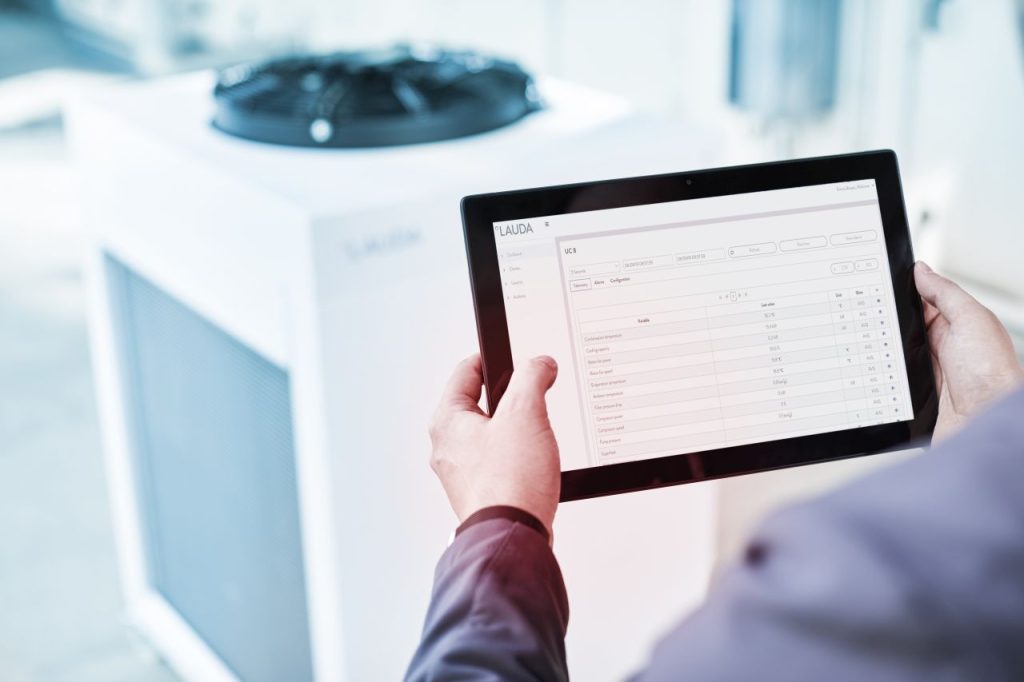
A cornerstone of LAUDA’s long-standing environmental strategy is the transition toward natural refrigerants.
By selecting refrigerants that balance thermodynamic performance, environmental impact and application requirements, LAUDA develops cooling systems designed to combine reliable temperature control with reduced environmental impact.
However, choosing a natural refrigerant is only one part of sustainable refrigeration. The overall efficiency of a system also depends on its compressor technology, heat exchangers, temperature range, operating conditions and control strategy.
For laboratories and industrial facilities, selecting an appropriately sized and efficient cooling system can help reduce electricity consumption and operating costs throughout the equipment’s service life.
Natural refrigerants and the EU F-Gas Regulation
The transition toward natural refrigerants is also being driven by environmental legislation. The European Union’s F-Gas Regulation (EU) 2024/573, which has applied since 11 March 2024, introduces stricter measures to reduce the use and emissions of fluorinated greenhouse gases.
The regulation includes a progressive phase-out of hydrofluorocarbons (HFCs) placed on the EU market, with the quota reaching zero by 2050, alongside restrictions on certain equipment categories.
By offering a comprehensive range of refrigeration solutions designed for compatibility with low-GWP and natural refrigerants, LAUDA empowers customers to adopt future-proof, environmentally responsible technologies, customized to meet the specific demands of their applications.
For laboratories and industrial facilities investing in new cooling equipment, this creates an incentive to consider solutions using low-GWP or natural refrigerants. By offering refrigeration systems designed for natural refrigerants, LAUDA supports customers looking for environmentally responsible temperature control solutions that align with evolving regulatory requirements.
The specific regulatory requirements depend on the equipment category, refrigerant and application.
R744 refrigerant: when is CO₂ the right choice?
Carbon dioxide (R744) is a natural refrigerant with a GWP of 1. It is non-flammable and offers favorable heat transfer characteristics, making it suitable for certain high-performance refrigeration applications.
R744 can be particularly interesting for:
Indoor installations
Applications requiring temperatures below 0 °C
Systems with a central cooling water supply

CO₂ refrigeration systems can provide precise temperature control and compact designs. However, they typically operate at substantially higher refrigerant pressures than many conventional systems, requiring components specifically designed for these conditions.
The suitability of R744 therefore depends on the cooling temperature, heat rejection conditions, required capacity and system architecture.
R290 refrigerant: when is propane more suitable?

Propane (R290) is a natural hydrocarbon refrigerant with very low GWP and favorable thermodynamic properties.
Depending on the equipment design, R290 can be used in:
Indoor and outdoor installations
Air-cooled and water-cooled systems
Applications operating above 0 °C
R290 can also support sub-zero cooling applications, so its suitability is not limited to temperatures above freezing.
One important consideration is that propane is classified as an A3 refrigerant, meaning it has high flammability. Systems using R290 therefore require appropriate safety engineering, which may include refrigerant charge limitations, leak detection, ventilation and other protective measures.
For example, LAUDA’s Ultracool recirculating chillers incorporate a gas detection and safety concept designed for their propane refrigerant systems.
With appropriate system design and installation conditions, R290 can offer an efficient, low-GWP alternative to fluorinated refrigerants in laboratory and industrial cooling applications.
R290 vs R744: what are the main differences?
Although both refrigerants offer a low environmental impact in terms of direct greenhouse gas emissions, their technical characteristics differ.
Characteristic | R290 (propane) | R744 (CO₂) |
|---|---|---|
Refrigerant type | Hydrocarbon | Carbon dioxide |
GWP | Very low | 1 |
Flammability | High (A3) | Non-flammable (A1) |
Operating pressure | Relatively moderate | High |
Cooling temperature | Depends on system design | Depends on system design |
Main consideration | Flammability and installation safety | High-pressure system design |
Neither refrigerant is universally better. The most appropriate choice depends on the application, required cooling capacity, temperature range, installation environment and overall system efficiency.
How to choose the right natural refrigerant for your application
When selecting a cooling system for laboratory or industrial use, several factors should be evaluated.
1. Required operating temperature
Determine the temperature range that the system must maintain. Both R290 and R744 can support different temperature ranges, but the achievable performance depends on the specific refrigeration system.
2. Cooling capacity and process requirements
The required cooling capacity, process heat load and temperature stability influence the selection of equipment and refrigerant technology.
3. Installation environment
Indoor or outdoor installation, available ventilation, space limitations and existing cooling water infrastructure can influence which solution is appropriate.
4. Safety requirements
R290 requires appropriate precautions because of its flammability, while R744 systems must be designed for high operating pressures and potential CO₂ accumulation in the event of a leak.
5. Energy efficiency and operating costs
The total energy consumption of a cooling system depends on its design and operating conditions. Comparing energy efficiency at the actual application conditions is therefore more useful than selecting a refrigerant based on GWP alone.
By evaluating these factors together, laboratories and industrial facilities can select cooling equipment that balances performance, safety, environmental impact and long-term operating costs.
Discuss your application with our Xperts
Our Xperts are happy to discuss your application and help you find the right solution.
FAQ
What is the difference between natural refrigerants and F-gases?
Natural refrigerants include substances such as propane, carbon dioxide and ammonia. F-gases are fluorinated gases, many of which have a significantly higher GWP. Natural refrigerants are increasingly used as alternatives in applications where their performance and safety characteristics are suitable.
Is R290 better than R744?
Not necessarily. R290 and R744 both have low GWP values but differ in flammability, operating pressures and refrigeration characteristics. The best choice depends on the cooling system and its intended application.
Are natural refrigerants suitable for laboratory chillers?
Yes. Natural refrigerants can be used in laboratory and industrial chillers when the equipment is specifically designed for them. Suitability depends on temperature requirements, cooling capacity, installation conditions and safety considerations.
Does using a natural refrigerant automatically reduce energy consumption?
No. Natural refrigerants can reduce the direct climate impact of refrigerant emissions, but energy consumption depends on the overall refrigeration system design and operating conditions. Compressor efficiency, heat exchanger performance, temperature setpoints and system sizing also play important roles.
Are natural refrigerants compliant with EU F-Gas regulations?
Natural refrigerants such as R290 and R744 are not HFCs subject to the EU’s HFC phase-out quotas. However, equipment using them must still comply with applicable product, installation and safety requirements.