
 English
 Dutch
 French
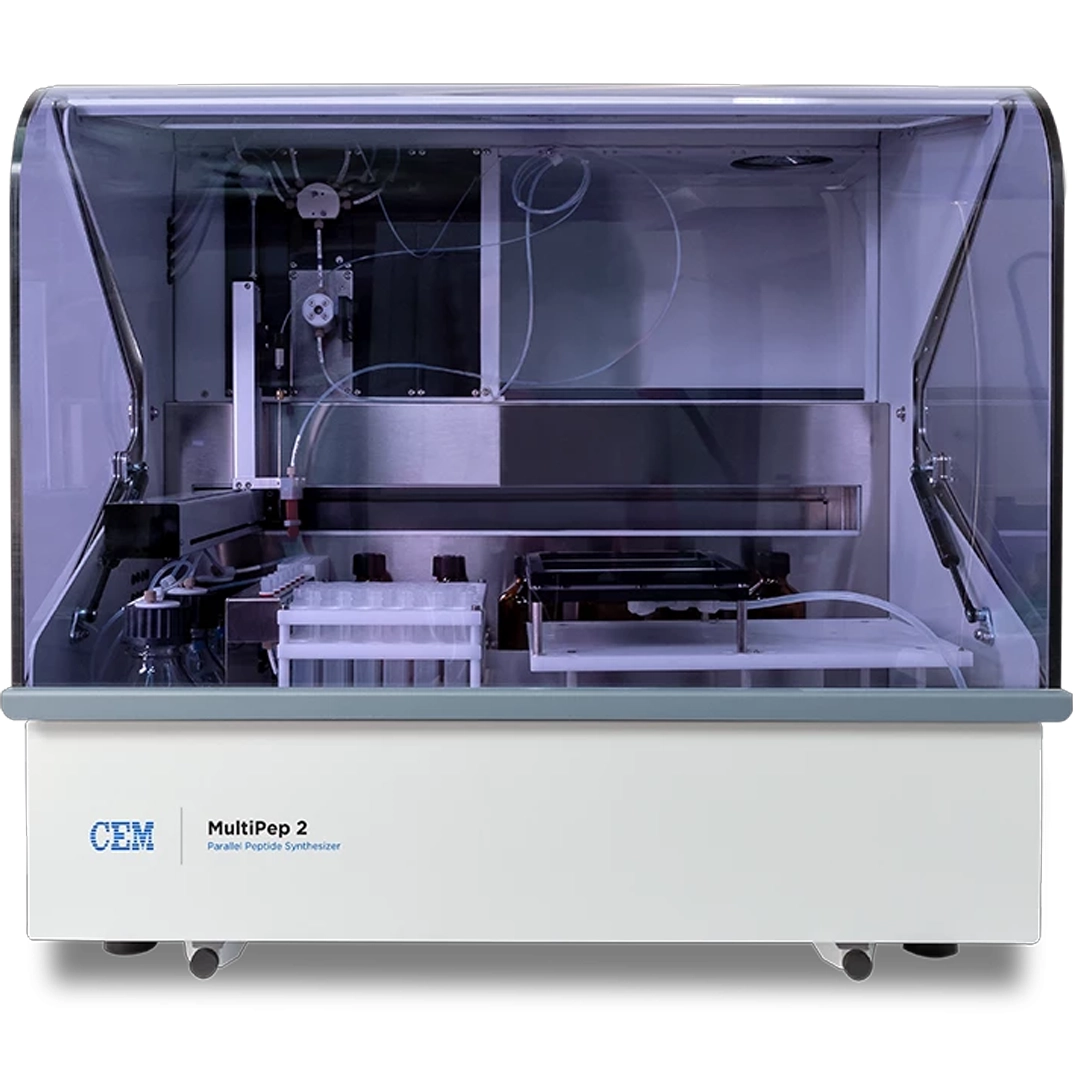
Automated Parallel Peptide Synthesizer
The MultiPep 2 is a state-of-the-art automated parallel peptide synthesizer designed for high-throughput screening of large peptide libraries. It enables simultaneous synthesis of hundreds to thousands of peptides using plate-based, column-based, or cellulose membrane formats, offering broad flexibility for research and discovery workflows.
Flexible synthesis formats
The system supports multiple scalable synthesis configurations:
- Plates: up to 384 peptides (4 × 96 format) at 1–10 μmol
- Columns:
- 48 mini-columns (0.25–0.50 mL) at 1–15 μmol
- 48 columns (2, 5, 10, 20 mL) at 10–500 μmol
- 72 columns (2, 5, 10 mL) at 10–300 μmol
- SPOT synthesis: up to 2400 peptides on four cellulose membranes
- CelluSpots: up to 768 peptides on dissolvable cellulose support for generating multiple identical peptide arrays
This range of formats allows flexible adaptation between small-scale screening and high-density library production.
Elevated temperature peptide synthesis
The MultiPep 2 includes an optional heating module that enables elevated temperature synthesis in both plate and column formats. Adjustable heating blocks allow controlled thermal conditions, which can improve synthesis outcomes, particularly for difficult or longer peptide sequences.
Key operational features
Core system functionality is designed to support efficient parallel synthesis:
- Fast synthesis using an 8-position parallel washing arm
- Vortex mixing for improved reaction homogeneity
- Pre-activation or in-situ activation chemistry options
- Flexible automation for multi-format workflows
Peptide library synthesis
The system is optimized for high-throughput peptide library generation. Depending on configuration, users can:
- Run up to 4 × 96-well plates simultaneously for 384 parallel peptides
- Use mini-columns (0.25–0.5 mL) for up to 72 parallel syntheses
- Run larger column formats for medium- to high-scale peptide production
This makes the system suitable for both screening libraries and more material-intensive synthesis workflows.
SPOT synthesis for high-density peptide arrays
SPOT synthesis enables immobilized peptide microarray production on cellulose membranes. With the MultiPep 2, up to 2400 peptides can be synthesized in a single batch. These peptide arrays are commonly used for:
- Binding studies
- Cell-based assays
- Solution-phase screening applications
CelluSpots technology
CelluSpots technology enables the production of multiple identical peptide arrays on glass slides. It combines traditional SPOT synthesis with a dissolvable cellulose support and uses a slide spotting process to generate replicated arrays for downstream applications.
Peptide nucleic acid (PNA) synthesis
The system supports small-scale peptide nucleic acid synthesis, which is particularly useful for expensive monomers. It enables synthesis at scales as low as 1 μmol and supports up to 48 parallel reactions using small-volume columns (250 μL and 500 μL formats).
Resin handling efficiency
To improve workflow efficiency in high-density plate synthesis, the system can be equipped with a 96-well resin distributor. This device enables fast and uniform distribution of dry resin into 96-well plates, improving accuracy and reducing manual handling time. It is compatible with polystyrene and ProTide resins.
Software and process control
The MultiPep 2 includes intuitive software designed for flexible experimental setup and detailed process monitoring. Key functions include:
- Import and export of peptide sequences
- Preconfigured synthesis protocols
- Prediction tools for difficult sequences
- Reagent consumption calculations
- Real-time process monitoring
- Full documentation of synthesis runs
MultiPep 1 vs. MultiPep 2
| Feature | MultiPep 1 | MultiPep 2 |
|---|---|---|
| Scale range | 0.001 – 0.3 mmol | 0.001 – 0.5 mmol |
| Synthesis formats – Well plates | 1 × 96‑well plate | 4 × 96‑well plates |
| Synthesis formats – Mini‑columns | 24 / 48 mini‑columns (250, 500 µL) | 24 / 48 mini‑columns (250, 500 µL) |
| Synthesis formats – Columns | 8 columns (2, 5, 10 mL) | 48 columns (2, 5, 10, 20 mL) 72 columns (2, 5, 10 mL) |
| Micro peptide arrays | SPOT synthesis on cellulose membranes Up to 1,200 peptides in parallel on 2 sheets |
SPOT synthesis on cellulose membranes Up to 2,400 peptides in parallel on 4 sheets |
| Copies of arrays (CelluSpots) | Many copies of arrays up to 768 peptides each using SlideSpotter | Many copies of arrays up to 768 peptides each using SlideSpotter |
| Amino acid positions | 26 standard (up to 48) | 31 standard (up to 48) |
| Other positions | Up to 15 | Up to 20 |
| Fluid delivery | Digital syringe pump | Digital syringe pump |
| Dimensions (W × D × H) | 22.8″ × 20.9″ × 28.3″ (58 × 53 × 72 cm) |
35.0″ × 25.6″ × 31.1″ (89 × 65 × 79 cm) |
| Accessories | CleavagePro™ SlideSpotter — CelluSpots |
CleavagePro™ SlideSpotter — CelluSpots |


