 English
 Dutch
 French


Six-cell diffusion block
The Phoenix DB-Max is a six-cell diffusion block designed for release-rate testing of six vertical diffusion cells simultaneously using manual sampling methods. The system supports 21 CFR Part 11 compliance and combines precise temperature control, powerful stirring, and computerized operation in a compact benchtop footprint.
Controlled through an advanced color touchscreen display, the Phoenix DB-Max provides uniform heating and stirring across all six diffusion cells while helping laboratories save valuable bench space.
Precise heating without a water bath
The Phoenix DB-Max uses a programmable dry heat block instead of conventional water jackets, pumps, and tubing. It is possible to heat the receptor media from 25 °C to 45 °C, with a stated accuracy of ±1.0 °C and typical performance within ±0.3 °C.
Starting from room temperature, the dry heat block and all six diffusion cells typically reach the target temperature within 30 minutes or less.
Powerful mixing and homogenization
Uniform receptor media is essential for reliable IVRT and IVPT testing. The Phoenix DB-Max uses custom-designed mixer inserts driven by powerful brushless motors to rapidly homogenize the contents of each receptor cell.
The combination of grooved mixers and strong magnetic drives helps prevent the formation of diffusion-rate barriers directly beneath the membrane, reducing variability in release-rate measurements. Stirring speed is programmable from 200 to 900 rpm with an accuracy of ±10%.

Bubble detection and removal
Air bubbles trapped beneath the membrane can affect release-rate results. The Phoenix DB-Max includes a lighted mirror that makes bubble detection quick and straightforward. When observing a bubble, it is possible to remove it by lifting and tilting the diffusion cell so it exits through the top of the sampling arm.
For laboratories looking to automate this process, the DB-Max can also be integrated into the Phoenix Flex, which provides automated bubble removal as part of an automated diffusion testing workflow.
Advanced touchscreen control
The Phoenix DB-Max is operated using a Linux-based single-board computer integrated into a color touchscreen display. Its built-in SQL database provides fast processing and data storage, while power and communication are handled through a single cable connected to the diffusion block.
The detachable touchscreen can be handheld or attached magnetically to the front or side of the instrument. The durable resistive touchscreen responds immediately and you can operate it with or without laboratory gloves.
The DB-Max also supports advanced method programming, user profiles and step-by-step test guidance with an audit trail.
During a test, the interface displays key information including:
- Temperature
- Stirring speed
- Elapsed test time
- Time remaining until the next sampling point
As each sampling interval approaches, the system provides both an audible alert and an on-screen countdown.
Support for 21 CFR Part 11 compliance
The Phoenix DB-Max includes features that support laboratories operating under 21 CFR Part 11 requirements, including:
- Self-calibrating speed control
- Built-in diagnostics with immediate on-screen alerts
- Audit logs for events, errors, test reports, test history, and service records
- Serial number tracking for multiple system components
- Real-time clock
- Serial printer connectivity
- Security settings for up to 50 users and administrator profiles
- Automatic inactivity timeouts
- Incorrect login lockout
Designed for future automation
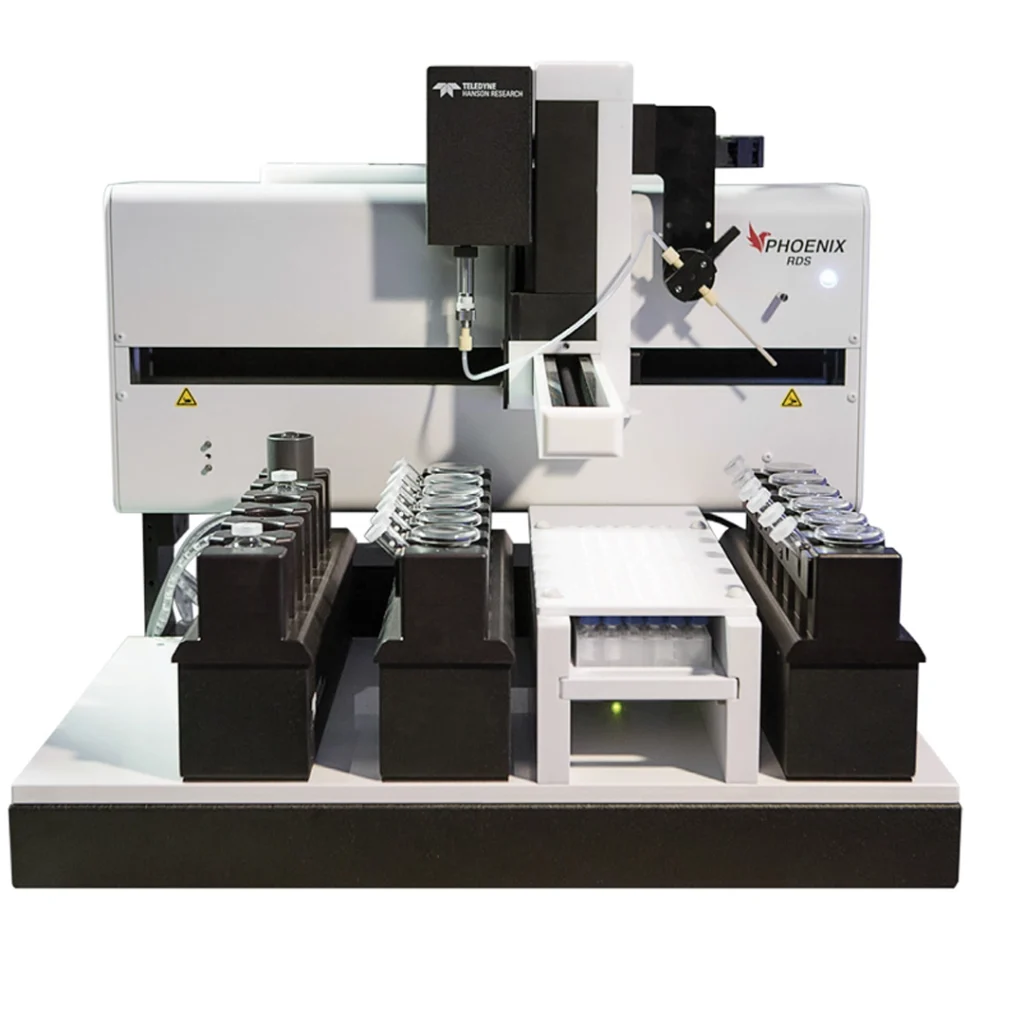
The Phoenix DB-Max simplifies the transition from manual to automated sampling. Each DB-Max diffusion block can be integrated directly into either the Phoenix RDS or Phoenix Flex without modification, allowing laboratories to scale up their testing workflow while protecting their existing investment
Transition to automation
Phoenix DB-Max blocks reduce costs when scaling up operations and transitioning from manual to automated sampling. The DB-Max can be integrated directly into the Phoenix RDS platform or the Phoenix Flex without modifucation.
Supply kit
Each Phoenix DB-Max comes with start-up supplies including six evaporation caps, six stoppers, and one each of the following:
- 20 mL disposable syringe
- Tweezers
- Dosage mixer
- Stainless steel laboratory spatula
- Bubble inspection mirror
- Plastic O-ring tool
Phoenix diffusion cells
Phoenix diffusion cells are designed for durability, versatility and ease of use. Because the cells operate with dry heat, no water jacketing is required, allowing them to be manufactured from heavy-duty borosilicate glass with tight dimensional tolerances.
Extract-and-replace sampling is performed through the large-diameter opening in the sampling arm, which accommodates standard pipette tips of approximately 300 μL.