Choose your region:

Teledyne Labs

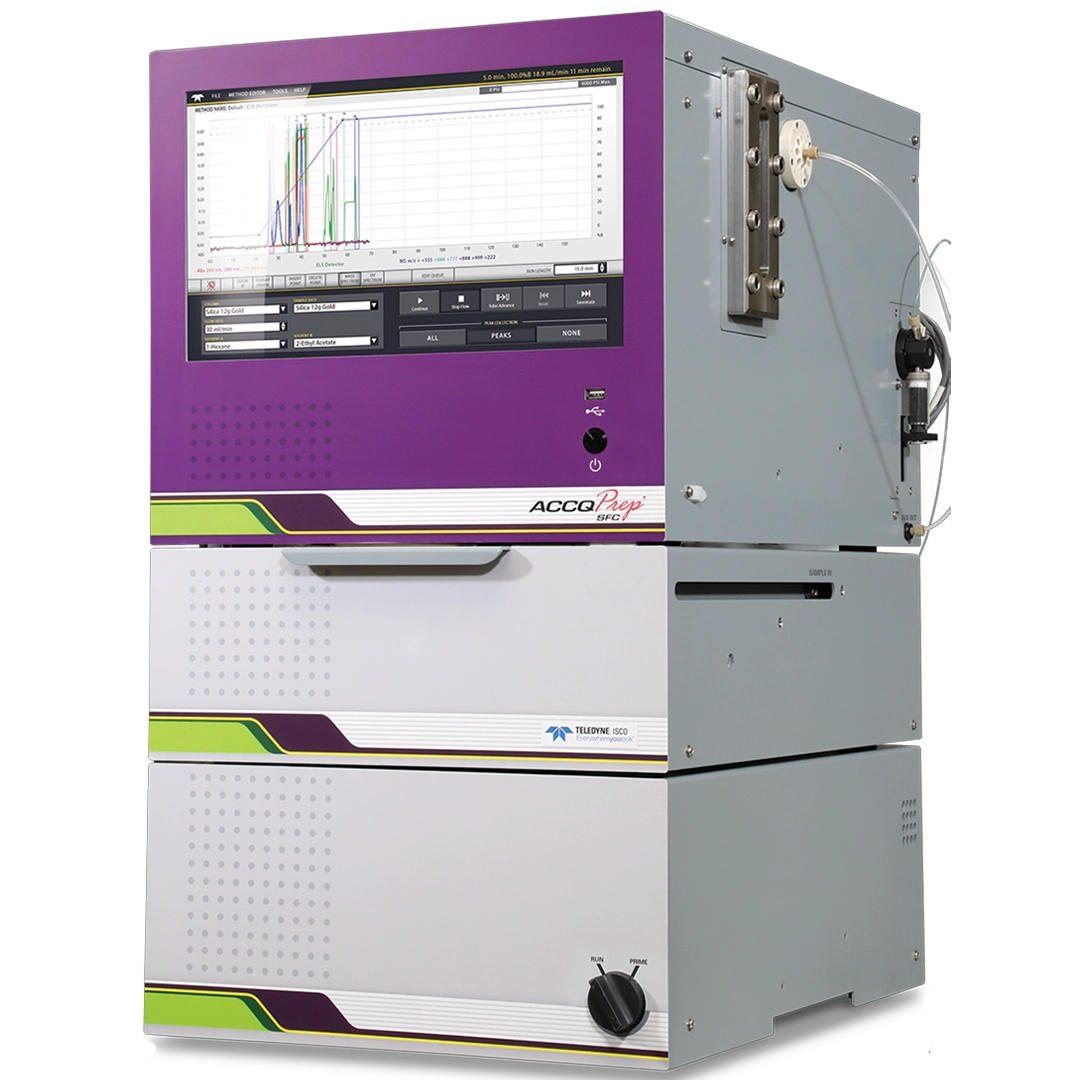
ACCQPrep SFC

Supercritical Fluid Chromatography system designed for both chiral and achiral separations
Flow rates range from 50 to 200 mL/min
Columns up to 3 cm
Integrated make-up pump for high COâ‚‚ composition

ACCQPrep SFC

Preparative SFC – Supercritical Fluid Chromatography system

What is the ACCQPrep® SFC system?

The ACCQPrep® SFC Supercritical Fluid Chromatography system from Teledyne LABS is a compact preparative SFC solution for both chiral and achiral separations. It combines ease of use with high performance in a single system.

The platform simplifies method development and improve accessibility for users of all experience levels. It supports both bulk collection from injections and multi-sample open-access workflows within a compact footprint.

Green and efficient chromatography

Supercritical COâ‚‚ is used as the primary mobile phase. It is environmentally friendly, cost-effective, and reduces the use of strong organic solvents by up to 95%. This results in lower solvent waste and reduced environmental impact while maintaining high separation efficiency.

COâ‚‚ is non-toxic, non-flammable, and easy to remove from samples. It can also be reused or captured from other processes, supporting more sustainable workflows.

System design and performance

To manage the properties of supercritical COâ‚‚, the system integrates a robust COâ‚‚ pumping system, an advanced mass-flow controller, and automated backpressure regulation. These components ensure stable flow control under varying conditions.

A patented Gas-Liquid Separator (GLS) reduces carryover and resists clogging, while supporting high cosolvent flow before fraction and waste collection. A standard fractionation valve distributes collected fractions into up to eight vessels or directs them to SFC AutoSampler systems for open-bed collection, achieving over 95% recovery at flow rates up to 200 mL/min.

Flow rates range from 50 to 200 mL/min, and the system is designed for columns up to 3 cm.

Software and control

The system operates through PeakTrak® software, accessible via an integrated 15-inch touchscreen interface. Method setup includes gradient, temperature, and backpressure parameters. The software automatically calculates GLS and fraction collection delay settings based on cosolvent composition.

PeakTrak® simplifies method development and reduces the learning curve while allowing remote control via network connection.

Detection and fraction collection

UV and UV-Vis detectors use photo diode array (PDA) technology, allowing spectra to be displayed in real time or after runs. Fraction collection can be based on purity indicators.

A fractionation valve directs collected material into up to eight vessels or external collection systems.

Multiple injection modes 

The system supports multiple injection modes:

  • Single injections
  • Multiple injections
  • Stacked injections

An AutoInjector can be combined with an SFC AutoSampler for multi-sample processing, automated wash cycles, and improved repeatability. RFID-enabled collection racks reduce errors such as missed or overfilled tubes.

Advantages of SFC compared to HPLC

Although SFC operates on similar principles to HPLC, the use of supercritical COâ‚‚ allows significantly higher flow rates. As a result, SFC is typically three to four times faster than HPLC.

Additional advantages include:

  • Reduced solvent consumption (up to 95% less strong solvent use)
  • Lower solvent waste generation
  • Up to seven times lower energy consumption for solvent removal
  • Environmentally friendly operation with reduced hazardous solvent use
  • COâ‚‚-neutral potential through reuse of captured COâ‚‚
  • Suitability for food and pharmaceutical applications when combined with appropriate co-solvents
Key features

  • Compact footprint for reduced laboratory space requirements
  • Operation of both chiral and achiral separations
  • Bulk collection and multi-sample open-access capability
  • Integrated make-up pump for high COâ‚‚ composition
  • Liquid cosolvent pump with a 4-solvent selection valve (5–70% composition range)
  • Automated backpressure control and mass-flow regulation

Specifications

Flow rate range 50–200 mL/min
Gradient linearity ± 1 %
System co‑solvent range 5–70 %
System backpressure range 100–160 bar
Maximum system operating pressure 414 bar
Column selector valve Standard; supports up to 6 columns
(2 or 3 cm × 25 cm or less)
Column oven (temperature range) Standard: +5 °C above ambient to 70 °C

Questions about your application?

Our Xperts are happy to answer your questions and provide additional information about this instrument and its applications.

Frequently asked questions

Supercritical Fluid Chromatography (SFC) uses a mobile phase based on carbon dioxide in its supercritical state. A supercritical fluid forms when a substance is exposed to specific temperature and pressure conditions where liquid and gas phases are no longer distinguishable.

COâ‚‚ behaves as a gas under normal conditions, forms dry ice at low temperatures and high pressure, and becomes a supercritical fluid at specific temperature and pressure conditions. In this state, it has unique properties that make it suitable for chromatographic separations.

Because COâ‚‚ alone cannot separate all compounds, it is typically combined with co-solvents such as methanol or ethanol.

Supercritical COâ‚‚ is non-toxic, non-flammable, and easy to remove from samples. Its use can reduce strong organic solvent consumption by up to 95%, resulting in lower solvent waste, reduced environmental impact, and more sustainable chromatography workflows.
The system uses supercritical CO₂, which can be reused or captured from other processes, supporting CO₂‑neutral strategies. Lower solvent use also reduces energy demand for solvent evaporation, contributing to environmentally responsible purification.
The patented Gas‑Liquid Separator (GLS) reduces carryover, resists clogging, and enables high cosolvent flow prior to fraction and waste collection. This design supports over 95% sample recovery at flow rates up to 200 mL/min.
RFID‑enabled collection racks reduce common errors such as missed or overfilled tubes, improving reliability and traceability during fraction collection in multi‑sample workflows.
Compared to HPLC, SFC is typically three to four times faster due to higher achievable flow rates. It also consumes significantly less solvent and requires less energy for solvent removal.
Preparative SFC offers faster separations, up to 95% reduction in strong solvent use, lower solvent waste, up to seven times lower energy consumption for solvent removal, and a more environmentally friendly purification process.
The ACCQPrep® SFC combines green chromatography, high throughput, automation, and a compact design in a single platform. It enables efficient, scalable separations while reducing environmental impact and simplifying method development.

Downloads

AccqPrep SFC brochure

Related instruments

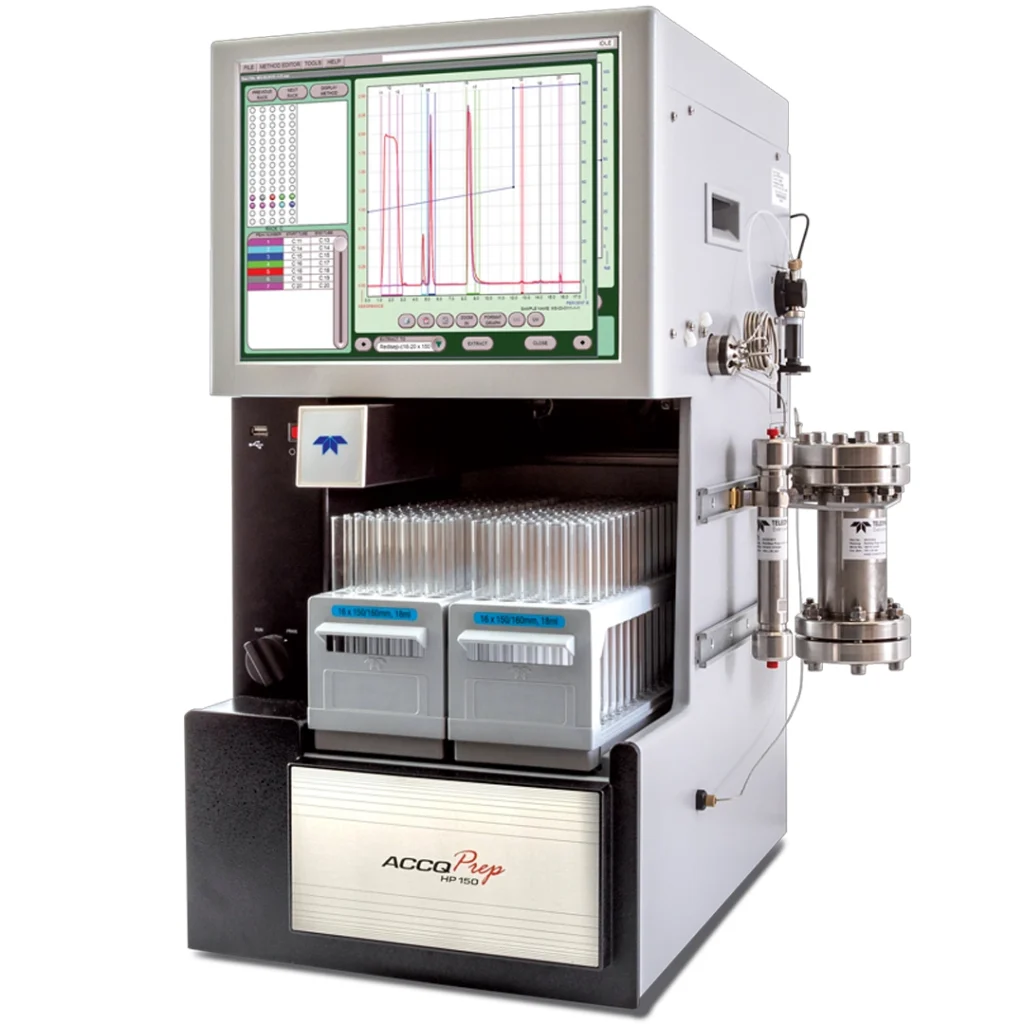
ACCQPrep HP150

High performance liquid chromatography (HPLC) system for intuitive operation while maintaining performance and accuracy
Flow range from 1 mL/min to 150 mL/min
Operating pressure up to 6,000 psi

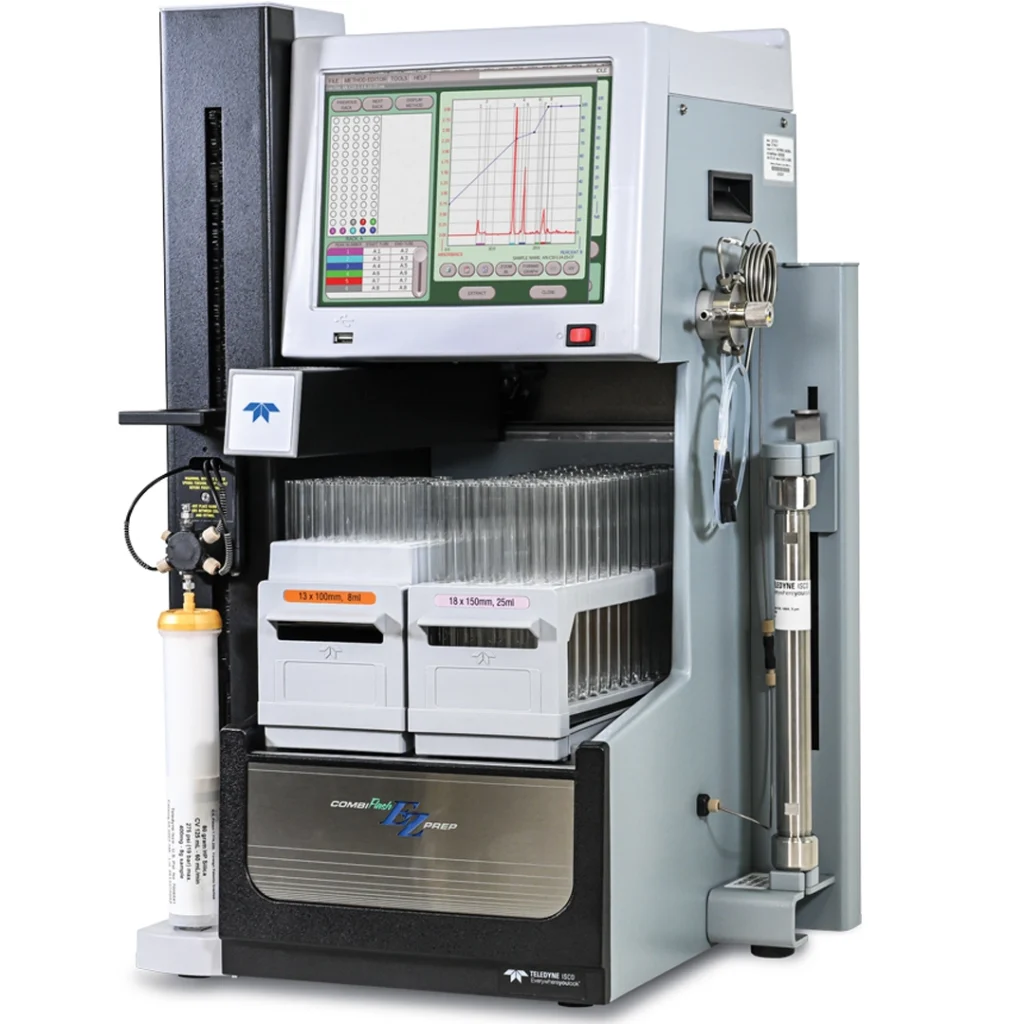
Combiflash EZ Prep

No need for two separate setups, switch easily between flash and Prep HPLC modes
Both flash and preparative (Prep) chromatography on a single instrument
Pressure up to 3,500 psi (240 bar)

CombiFlash NextGen 300+

The CombiFlash NextGen 300+ comes standard with all options installed
Flow rates from 1 to 300 mL/min
Operating pressure up to 300 psi (20 bar)

Last viewed products

No products found

Contact our Xperts

Prefer to give us a call?

Belgium & Luxembourg
+32 (02)2 334 22 70

Please select your country

By selecting your country, we can show you the products that are available for you and your organisation.